
**“Canada does not have an AI supply problem. It has a demand problem.”
** – Chris Arsenault, Inovia Capital
**“Choosing not to invest in our Canadian AI champions means choosing to depend on everyone else’s.”
** – Chris Arsenault, Inovia Capital
Canada trains approximately 10% of the world’s top artificial intelligence (AI) talent, yet captures only 2% of global venture capital invested in the sector. For Chris Arsenault, Founder and Partner at Inovia Capital, this imbalance points to a very specific issue: the country innovates, but still struggles to turn that expertise into economic power.
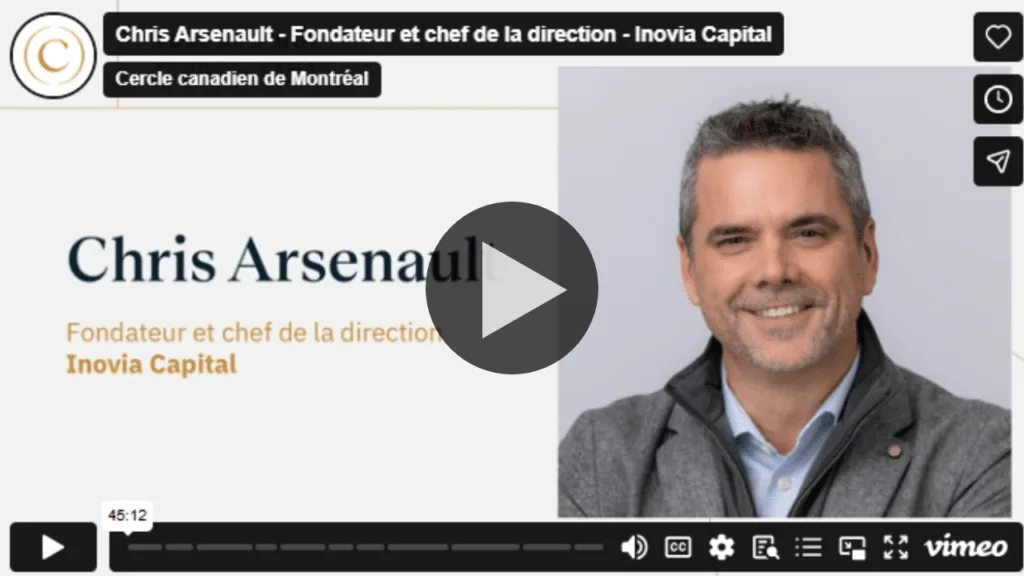
Speaking to members of The Canadian Club of Montreal on May 11, Chris called for faster innovation adoption and stronger support for homegrown technology companies in order to create value here in Canada. “Canada does not have an AI supply problem. It has a demand problem,” he said.
The situation is concerning, in his view. In 2024, two-thirds of Canada’s high-potential startups were based outside the country¹. More than half of the venture capital invested in Canada came from the United States². As a result, the country produces world-class researchers, entrepreneurs, and technologies, but a significant share of the value created ultimately leaves the country.
“We are leaders in research, but underrepresented in value creation,” Chris Arsenault summarized. In his view, Canada is now at an “inflection point,” as AI breakthroughs move from university labs into companies capable of transforming entire industries. The challenge is creating the right conditions for those companies to grow here.
Speed as a strategic advantage
One word came up repeatedly throughout his remarks: velocity.
For Chris Arsenault, the ability to make decisions and execute quickly has become a core competitive advantage. In leading technology ecosystems, moving fast is no longer even an advantage. “It’s the baseline requirement.”
The problem, in his view, is that too many Canadian organizations remain paralyzed by analysis and the search for certainty before taking action. While they deliberate, competitors move ahead. “Today, slowness is a greater risk than making mistakes.”
He compared this dynamic to a game of snakes and ladders: while one company continues building analyses and plans, a more agile competitor is already changing the rules of the game. The result is having to restart the process from scratch, always further behind.
To illustrate this contrast, Chris pointed to the U.S. model. In the United States, large corporations adopt emerging technologies quickly, governments act as early customers, and major enterprises invest heavily in startups and venture capital funds.
“Innovation is a speed lever and a competitive advantage, and they understand that.”
From Gaspésie to global tech
The founder of Inovia’s personal journey directly informs this perspective.
Originally from Bonaventure, in Québec’s Gaspé region, Chris Arsenault said he recognized the transformative potential of technology early on when he first encountered a TRS-80 computer.
“Technology could rewrite the rules in almost every industry,” he explained.
That conviction led him to launch his first internet company in the 1990s, and later to co-found Inovia Capital in 2007 with an initial C$112 million fund.
Nearly twenty years later, the firm manages over US$2.5 billion and has offices in Montreal, Toronto, Waterloo, Calgary, London, and Abu Dhabi.
Chris also highlighted how dramatically the Canadian ecosystem has evolved. In 2007, roughly C$550 million was invested annually in Canadian technology companies. By 2025, that figure had surpassed US$5.8 billion.
Last year alone, Inovia portfolio companies raised US$1.7 billion, including companies such as Cohere and Wealthsimple.
Turning research into companies
To accelerate AI development in Canada, Inovia is pursuing several initiatives.
Chris highlighted the firm’s partnership with Mila, the Québec AI Institute, to raise the Venture Scientist Fund, a US$100 million initiative aimed at helping researchers turn their work into technology companies built in Canada rather than the United States.
Inovia has also assembled a specialized AI team composed of former leaders from Google DeepMind, Anthropic, OpenAI, and portfolio companies, including Cohere. Their role is to help accelerate AI adoption across portfolio companies.
Still, Chris believes the real challenge goes well beyond funding.
Canada must create a stronger domestic demand for its own technologies. “Convincing our governments and large enterprises to adopt innovation and AI as a strategy remains essential”, he emphasized.
In his view, Canadian startups still struggle to secure their first major domestic customers.
“Too often, those customers are in the United States.”
An issue of economic sovereignty
In closing, Chris Arsenault framed innovation within a broader geopolitical context.
The United States is investing aggressively in its national technology champions. China has pursued an explicit technological sovereignty strategy for over a decade. Europe is now strengthening its own strategic partnerships.
In that context, Canada can no longer afford to remain neutral, he argued.
“Choosing not to invest in our own Canadian champions means choosing to depend on everyone else’s.”
For Chris, innovation is not only a growth issue, but an economic sovereignty issue.
The goal is to build companies that create jobs here, develop intellectual property here, and pay taxes here, while competing globally.
“Canada has all the ingredients: talent, AI research, responsibility, diversity, and strong institutions. What we need is a velocity mindset.”
¹ *The Rise of the Canadian Venture Scientist, 2026
*² Canadian Venture Capital Market Overview, 2025